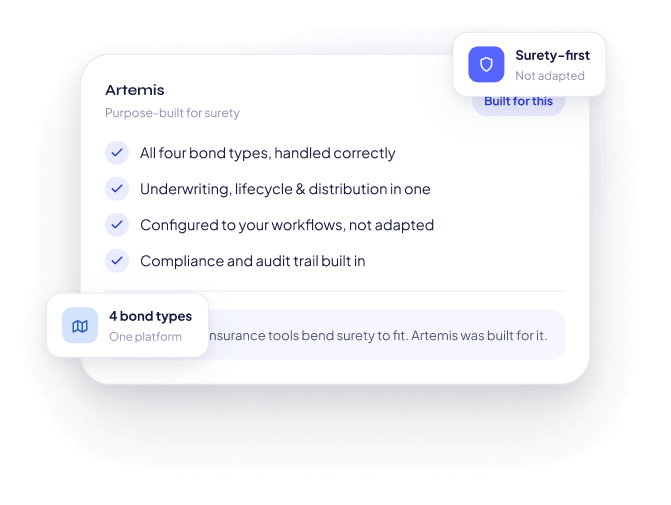
 Purpose-built for surety — not adapted
The case for choosing
purpose-built
There are options in surety technology. Here is why the right one is a platform designed from the ground up for this industry.
What the alternatives actually look like
Most carriers and MGAs evaluating surety technology today are choosing between three real options. None of them is purpose-built.

The incumbent system
The system already in place: a home-grown application built years ago to solve a specific problem, extended over time with workarounds, and now holding the operation together through a combination of institutional knowledge and manual effort. It works. It also cannot scale, cannot integrate easily, and cannot keep pace with the volume and complexity the industry is moving toward.
The adapted platform
A general insurance or workflow platform, configured until it sort of fits surety. It handles the easy parts — but bonds, obligees, and indemnity agreements were never the core model, so you inherit someone else's assumptions everywhere the configuration runs out.
The status quo
Sticking with spreadsheets and manual process. It keeps working right up until volume, headcount, or a new line of business makes the cost of doing nothing bigger than the cost of switching.
Designed from first principles around how surety actually works
Purpose-built does not mean customized. Here is what it looks like in practice.
When software is built for the way something actually works, you stop noticing it. That is the goal.
Every bond type handled correctly
Contract, commercial, fidelity and court bonds each have distinct underwriting logic, obligee requirements and lifecycle mechanics. A purpose-built platform doesn't treat them as variations of one workflow — it handles each correctly because each was considered in the design, not added later.
Every workflow built around the real process
The underwriting workbench was designed around how an underwriter actually reviews a file — WIP schedules, indemnity agreements and financial spreading built in, not bolted on. The claims module is built around the indemnity recovery process as the control mechanism, not a secondary consideration.
Every stakeholder in the same system
The distribution layer was built around the three-party legal chain, so agents, obligees and carriers work from the same document without re-entry or version risk — every party working from one source of truth.
Four reasons to choose Artemis
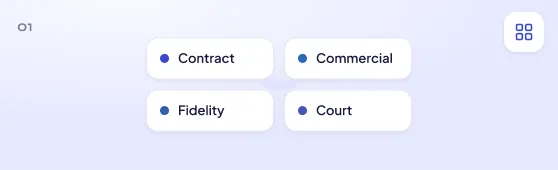
Every bond type, one platform
Contract, commercial, fidelity and court bonds each have their own rules. Artemis handles all four correctly in a single platform — without separate workflows, separate modules, or manual exceptions for bond types that don't fit a generic template.

AI that stays in its lane
Artemis uses AI to speed document extraction, triage standard risk submissions and surface information faster — not to replace underwriting judgment. Every AI-assisted output is human-reviewed, explainable on request and auditable end to end.

Every stakeholder connected
Agents, brokers, obligees and underwriters all need bond data — and none should have to ask someone else for an update they could access themselves. Artemis gives every party its own real-time access without creating re-entry risk or breaking the legal chain of execution.

Built to grow with the industry
Surety is growing and its platforms need to grow with it. Artemis was designed from the start for scale — infrastructure, API-layer, user management and product configuration all built to handle rising bond volume, expanding forms and new bond types without a rebuild every time the business grows.
Reserved for customer logos, metrics, or an attributed quote once real traction data exists.
We don't populate this with invented proof.
See Artemis in action.
The fastest way to understand what purpose-built means is to see it working.